You're a Clock, I'm a Clock
When I was in high school, I spent a couple of summers sweating through a black-and-white marching band uniform that never actually fit. My shako (a tall hat topped with a flamboyant plume) kept sliding down my forehead, covering my eyes so I looked like I was furrowing my brows at the crowd while trying my best to play John Philip Sousa.
In front of me, the drum major stood on a giant pedestal, swinging their hands: 1, 2, 3, 4, 1, 2, 3, 4. Undoubtedly sweating even more than I was.
If you have ever watched a marching band from the stands, you are looking at a sweet miracle of physical synchronization. A football field is an acoustic nightmare. Because sound travels slowly, if the trumpets in one end zone try to stay in step by listening to the battery in the other, the entire arrangement instantly collapses into a dragging, muddy smear.
We stayed in sync by ignoring our ears and locking our eyes on the drum major’s baton. Light travels fast enough to make their conducting instantaneous across a hundred yards, giving every kid on the field a single, shared, undeniable reference point for now.
We’re all a little network of clocks, and things get tricky when the tempo of light syncopates against the speed of sound. Down an analog cable, now is just now: the physical voltage is the sound. But when you chop that audio into digital packets and fling them across ethernet cables, you lose that physical simplicity. Packets arrive out of order, take different paths, and get delayed by switches. Worse, every network device has its own cheap internal clock ticking at its own slightly-wrong rate. 1, 3, 4, 1, 2, 3, 1, 4..
Without a drum major on the network, twenty enterprise audio boxes will collectively refuse to play a single note because they suspect they might be off-tempo, much like a last-chair euphonium player (sorry).
So the network needs a clock: a shared, sample-accurate sense of time that every box locks to, rather than a wall clock for humans. That network drum major is PTP, the Precision Time Protocol, standardized as IEEE 1588. It’s the quiet metronome underneath Dante, AES67, and SMPTE ST 2110, the standards you have likely heard named even if nobody explained what actually holds them together. As SMPTE’s own plain-language guide to the sync system refreshingly points out, the legacy sync systems we relied on for thirty years are showing their age. PTP is the digital-age replacement, and it gets sub-microsecond agreement across an ordinary network, ensuring that a room full of independent boxes behaves like a unit.
How the network picks who keeps time
In high school, our drum major earned the pedestal through a stressful, formal tryout in front of the band director. Meritocracy, a grueling head-to-head — in high school, we called them “challenges”. On a network, the devices are civil: they hold an election.
This process is called the Best Master Clock Algorithm (BMCA), and it runs in the background of your network every second of every day. Every device advertises its own credentials: where its clock comes from, how accurate its oscillator is, and how its network interface is connected. The network compares these resumes and collectively agrees on a single winner to be the Leader (you will still see the older term, “master,” in a lot of manual pages and configuration software). Everyone else becomes a Follower and disciplines its own internal clock to match.
On a Dante network this happens automatically, with no setup at all. A device with a GPS-disciplined external clock input wins, a gigabit-connected device beats an older 100-megabit box, and if the network is somehow faced with a dead tie, the lowest MAC address breaks it. It’s a small, self-organizing democracy that re-runs every time you plug something in or pull something out.
Once the election is settled and the drum major is on the pedestal, keeping everyone in step becomes a continuous conversation of timestamps. But before we look at the math, we have to litigate the massive, load-bearing assumption holding the entire roof up: symmetry.
For the arithmetic to work, a packet’s journey from Leader to Follower has to take the exact same number of nanoseconds as the return trip. On an isolated network with dedicated media switches, that’s a reasonable bet. On a standard corporate network crammed with office traffic, printer queries, and large file downloads? It is a massive leap of faith. If a switch delays the return packet by even half a microsecond, the math breaks, the Follower corrects for an error that does not exist, and the clock drifts.
If we assume perfect symmetry, however, the math laid out in Audinate’s PTP technical deep-dive is elegant in its simplicity.
The conversation relies on four timestamps (t1 through t4) exchanged between the Leader and a Follower:
Leader                          Follower
  |                                |
  |------ Sync -------------------->|
  |   sent t1              recv t2  |
  |                                |
  |<----- Delay Request ------------|
  |   recv t4              sent t3  |
| |- The Leader sends a Sync message and stamps its exact departure (t1). The Follower records its arrival (t2).
- The Follower sends a Delay Request back and stamps its departure (t3). The Leader records its arrival (t4).
Because the Follower’s clock is slightly out of alignment, the measured times include both the physical network delay and the clock offset. By subtracting the return-trip delay from the forward-trip delay, the Follower can isolate its clock error:
offset = ((t2 - t1) - (t4 - t3)) / 2By solving this equation a few times a second, every Follower on the network can continuously adjust its internal clock speed. It is a delicate, real-time feedback loop that forces a room full of independent silicon boxes to behave like a single, cohesive instrument.
Why the metronome breaks (and why it is always quiet)
If PTP is the invisible heartbeat of networked audio, it is also the first component to fail. When it does, it fails with absolute, polite silence. When a network clock loses its footing, there is no dramatic analog feedback or digital distortion: the system simply shuts its mouth.
A few things I’ve learned to suspect before anything else:
-
Your network switch is now part of the ensemble. Because PTP relies heavily on multicast traffic, a growing network can rapidly drown in its own timing coordination. Every follower device is constantly shouting questions at the leader, and on a basic switch, that chatter is broadcast to every single port. It is the network equivalent of every student in the band screaming “Are we in the A Section, or did we get to the Coda yet?? Oh, the B section?? Ah! Is that my solo? Maybe now’s my solo” — back to the drum major at the exact same time. The solution is not a more expensive Ethernet cable: it requires smart switches that actually understand PTP. Audinate details this N:N chatter problem and the boundary-clock fix directly. The RAVENNA engineering team notes a similar reality on the AES67 side: you frequently have to nudge a switch with an IGMP request before it will even forward the clock.
-
“Green light, no sound” is usually the clock. When PTP can’t lock, Dante gear mutes on purpose. The culprits can be mundane: encrypted VPN links, and power-saving Ethernet. In both cases, it’s some kind of connection that decides that timing doesn’t matter. In the marching band parallel: a maraca plays its own thing in the corner.
-
Two standard dialects, one clock, and an invisible translator. In a perfect world, standards would be standard. In our world, Dante historically speaks an older dialect of PTP (version 1), whereas AES67 and SMPTE ST 2110 require the modern version (version 2). To bridge this gap, a single AES67-enabled Dante device must step up to act as a boundary clock, translating between the two protocols on the fly. When two allegedly compatible hardware systems refuse to pass audio, this translation seam is the first place you should look.
This translation layer represents a broader diplomatic struggle. The AES and SMPTE committees had to publish a joint report on which PTP settings let AES67 and the broadcast profile coexist just so audio and video equipment could share a single clock. Honestly, it’s dry af to read, but it’s born from a simple, painful reality: getting different pieces of hardware to agree on the exact microsecond of now is an incredibly difficult engineering task, but it is the only way to keep the entire illusion of digital media from falling apart.
The metronome nobody applauds
I think the reason I like this engineering is that it rhymes with something I already knew as a musician. An ensemble doesn’t stay together because everyone is individually perfect; it stays together because everyone is listening to the same time. Take away the shared pulse and even great players smear. PTP is that pulse — a metronome nobody applauds, running in the background, the reason a hundred doohickeys can act like just one doohickey.
And it’s suddenly everywhere. The gear that used to gate this world behind broadcast budgets is getting cheap and ordinary: a mixer just shipped full ST 2110-30 and NMOS for $5,995, a public broadcaster rebuilt an entire radio truck as software on standard servers, and the Pro-AV world is busy certifying its own IP-media flavor, IPMX, for rooms far outside a TV station. Which means a lot more of us are about to meet the clock — hopefully by reading about it first, and not, like me, by standing in a silent room wondering why.
To me, this network clock is exactly the kind of invisible correctness I want my systems to automate. It represents a clean boundary where we can delegate the coordination details to the infrastructure, freeing up our minds to focus on what actually goes over the wire. We build these complex stacks and enforce their synchronization not because we love configuring switches, but because we need a floor of absolute coordination to stand on. Back on that high school football field, with the shako’s chain resting on my chin and my hands on my saxophone, I was not thinking about the physics of propagation delay. I was just trying to match the timing of the drum majors’ sweeping hands. The system worked because the drum major took care of the time, leaving us free to try and play John Philip Sousa.

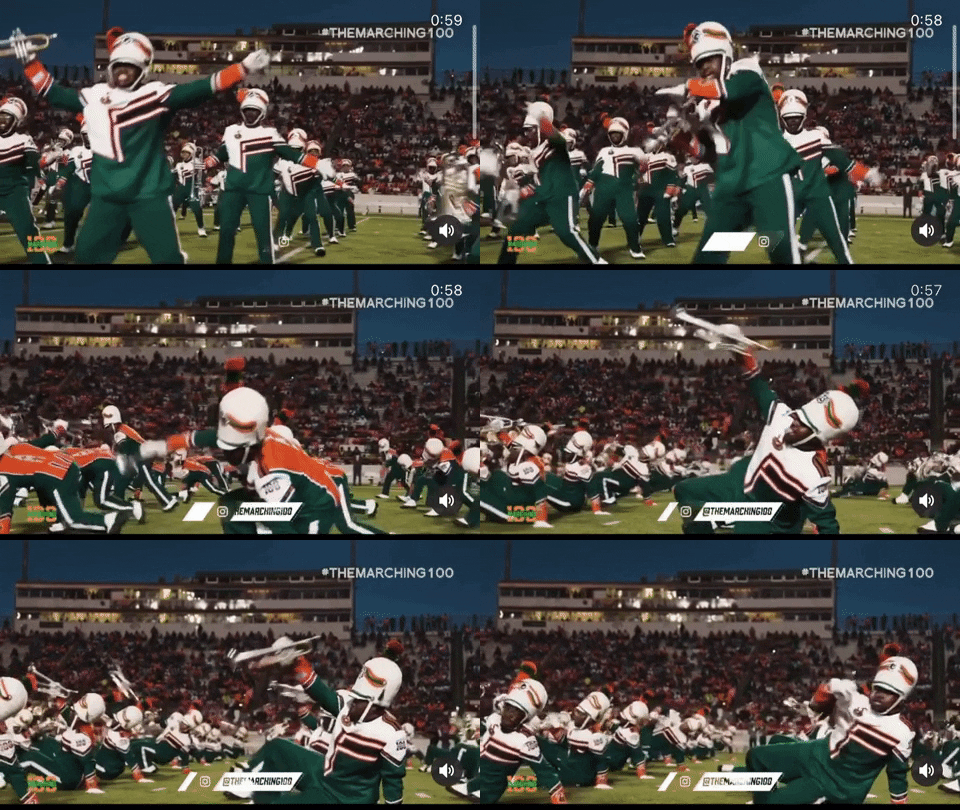
The marching-band clips up there are the FAMU “Marching 100” — some of the best to ever do it — pulled from HonestyB and Respective on GIPHY. Go watch the full clips, they’re worth it.
Sources (verified 2026-07-17):
- IEEE 1588 (Precision Time Protocol) — https://standards.ieee.org/ieee/1588/6825/
- SMPTE EG 2059-10:2023, Introduction to the New Synchronization System — https://pub.smpte.org/pub/eg2059-10/eg2059-10-2023.pdf
- SMPTE ST 2059-2 (SMPTE PTP profile) — https://github.com/SMPTE/st2059-2
- Audinate, How does Dante clocking work? — https://www.getdante.com/support/faq/how-does-dante-clocking-work/
- Audinate, Dante & Precision Time Protocol — Technical Dive (PDF) — https://www.getdante.com/wp-content/uploads/2025/05/DanteAndPrecisionTimeProtocol-TechnicalDive-20250507.pdf
- Dante Controller user guide, Clock Synchronization — https://dev.audinate.com/GA/dante-controller/userguide/webhelp/content/clock_synchronization.htm
- RAVENNA, AES67 Practical Guide (PDF) — https://ravenna-network.com/wp-content/uploads/2020/02/AES67-Practical-Guide-1.pdf
- RAVENNA, AES67 & SMPTE ST 2110 Timing & Synchronization (PDF) — https://ravenna-network.com/wp-content/uploads/2021/02/AES67-SMPTE-ST-2110-Timing-Synchronization.pdf
- AES standards (AES-R16, PTP interoperability report) — https://www.aes.org/standards/
- ProSoundWeb, Violet Audio Brings SMPTE ST 2110-30 & NMOS to the dMix 128 — https://www.prosoundweb.com/violet-audio-brings-smpte-st-2110-30-nmos-workflows-to-the-dmix-128/
- Sports Video Group, Bayerischer Rundfunk Debuts Software-Defined ST 2110 Radio OB Van — https://www.sportsvideo.org/2026/07/14/bayerischer-rundfunk-debuts-fully-software-defined-smpte-st-2110-radio-ob-van-built-around-lawo-technology/
- Sports Video Group, AIMS Schedules Second IPMX Certification Event — https://www.sportsvideo.org/2026/07/15/aims-schedules-second-ipmx-product-certification-event-for-august/